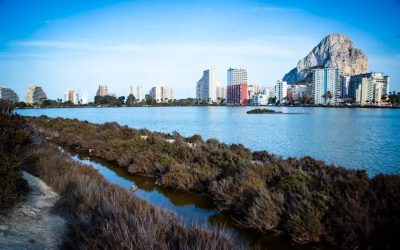
CALPE SALT FLATS
The Salinas de Calpe are an ancient saltworks site located in an endorheic depression (meaning the water has no outlet to the sea or rivers and instead accumulates) near the Mediterranean coast. This wetland, surrounded by urban areas but connected to the Peñón de Ifach Natural Park, covers about 40 hectares. Although salt is no longer extracted commercially, the area is now preserved as a valuable protected natural site.
It is a naturally saline environment that has been used since ancient times due to its geological characteristics. Unlike many artificial salt flats, those of Calpe formed spontaneously thanks to the accumulation of water over impermeable clay soil, which allowed salt to settle as the water evaporated. The exploitation of the Salinas de Calpe dates back at least to Roman times. Archaeological remains suggest its use as a source of salt during the Roman Empire, when this resource was essential for food preservation. However, it was during the Middle Ages and up until the 20th century that the salt flats reached their peak, becoming an important economic resource for the local population. In the 20th century, activity gradually declined, and systematic salt extraction was eventually abandoned.
Fortunately, instead of disappearing, this natural space was protected for its immense ecological value. Today, it forms part of an integrated urban environment and serves as a site for research, hiking, and guided visits.
This wetland hosts rich biodiversity, especially of waterfowl. In fact, it is one of the best birdwatching spots on the Costa Blanca. Among its most iconic inhabitants are the flamingos, which have become a symbol of the area. Other commonly seen species include black-winged stilts, grey herons, gulls, avocets, and many migratory birds that find in these salt flats a resting and feeding place during their journeys between Africa and Europe.
The flora is also noteworthy, with abundant halophilic vegetation (plants adapted to saline environments). This ecological balance, maintained even amid nearby human activity, demonstrates the resilience of the ecosystem and its value as a natural laboratory for biological and environmental studies.
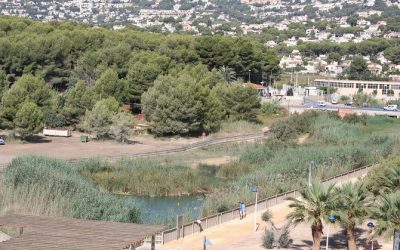
SENILLAR MARSH
The natural area of the Marjal del Senillar is a small coastal lagoon of brackish water located at the mouth of the Les Sorts ravine, next to the town of Moraira.
The presence of a sheet of water in this area is due, as in most Mediterranean wetlands, to the contribution of groundwater. The water supply to the Senillar comes from a small detrital aquifer (Les Sorts Roig), whose waters emerge through springs (known locally as ojos or ullals) that surface at the bottom of the flooded zone.
The Marjal del Senillar covers an area of approximately 1 hectare, almost half of which remains permanently flooded.
This wetland is the result of a restoration project carried out by the Town Council in 2002. Years earlier, the wetland had been drained and urbanized, which caused serious problems on the beach: it was destroyed by flooding and became dangerous after the sandy substrate was destabilized.
The restoration work recovered the three original zones: the lagoons (about one hectare in area), their banks, and the dune system, which preserves vegetation adapted to the low nutrient levels of the environment.
Located next to Ampolla Beach, in the municipality of Teulada-Moraira, the Marjal del Senillar is one of the most valuable ecosystems on the coast of the Marina Alta region. Declared a Wildlife Reserve in 2004, it is home to a population of the fartet fish (Aphanius iberus), a species in danger of extinction.
The shores of the wetland are covered by plant species such as common reed (Phragmites australis), rushes, common bulrush, and tamarisk (Tamarix spp.). In the dunes, one can find sea holly, sea fennel, sea daffodil, and marram grass.
Among the fauna, the most notable species include the common moorhen, mallard, and reed warbler among birds; the common frog, common toad, and viperine snake among amphibians and reptiles; mullets and eels among fish; and the gambeta (Dugastella valentina), an endemic Mediterranean crustacean.
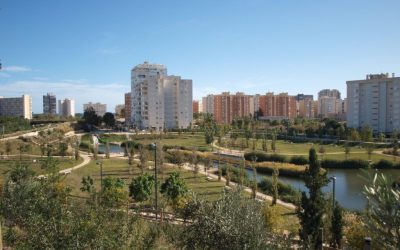
LA MARJAL PARK (ALICANTE)
Located just a short distance from Alicante’s Playa de San Juan, La Marjal Park is a pioneering green infrastructure in Spain, designed to protect the city from flooding — a common phenomenon in Mediterranean basins that is becoming increasingly frequent due to extreme rainfall caused by climate change.
The park covers 3.6 hectares of floodable area, with the capacity to collect up to 45,000 m³ of water during episodes of torrential rain.
It features an advanced intelligent monitoring system, which alerts citizens and coordinates with emergency services to ensure evacuation in case of heavy rain forecasts.
Two main collectors, located along avenues prone to flooding, channel runoff water into the park’s retention pond. This collected water is then sent to the Monte Orgegia wastewater treatment plant, where part of it is reused for irrigating green areas, contributing to the growth of urban greenery in recent years.
La Marjal Park is an urban green infrastructure inspired by natural marsh systems, typical Mediterranean wetlands that not only mitigate the impact of floods but also preserve biodiversity by serving as a refuge for local plant and bird species, including the protected kingfisher.
All plant species in the park are adapted to withstand up to 48 hours of submersion without significant damage when the retention basin fills during heavy rainfall.
This innovative space is the result of a collaboration between the Alicante City Council and Aguas de Alicante (a company jointly owned by Hidraqua, part of the Agbar group).
The park has already proven effective in mitigating the effects of several flood events, and throughout the rest of the year, it functions as a recreational green space for local residents — a model of how green infrastructure can integrate environmental protection, urban sustainability, and social well-being.